
Start with the job the artwork must perform
Your project needs a clear visual job before you compare artists. A watercolor piece might be intended to express a subject in a room, personalize a home, or provide artwork that becomes part of a product or interior surface. Those goals can point toward different kinds of work, so begin with the place, object, or experience the artwork must serve.
Your first decision is not whether an artist’s portfolio looks beautiful; it is whether the visible work gives you enough evidence for your particular brief. Write down:
- What should the artwork show?
- Where will you see or use it?
- Is the artwork a single image, or should a motif repeat across a surface?
- Which colors, mood, and details need to appear?
- What size, format, or production requirement must the final work meet?
This list gives you a practical starting point for judging both artist fit and project readiness.
Our practice specializes in watercolor illustration and surface pattern design. Surface pattern design involves creating repeatable designs for surfaces such as textiles and wallpaper. That distinction matters if your home project involves a particular illustrated scene or if your product project needs artwork that can repeat across fabric, wallpaper, or another surface. Name the job first, then assess whether the artist’s service matches it.
Your initial hiring screen can follow four questions:
- Purpose: What must the artwork do in the room, on the product, or across the surface?
- Form: Do you need one image, a repeat, several coordinated patterns, or a combination?
- Fit: Does the portfolio show related subjects, treatment, color, and medium?
- Brief: Can you explain the intended use, required details, and practical constraints?
If you cannot answer the first two questions, clarify the application before comparing portfolios. If you can answer them but cannot find related work, treat that as a fit question rather than assuming the artist can provide the requested direction.
Choose between a watercolor illustration and a surface pattern
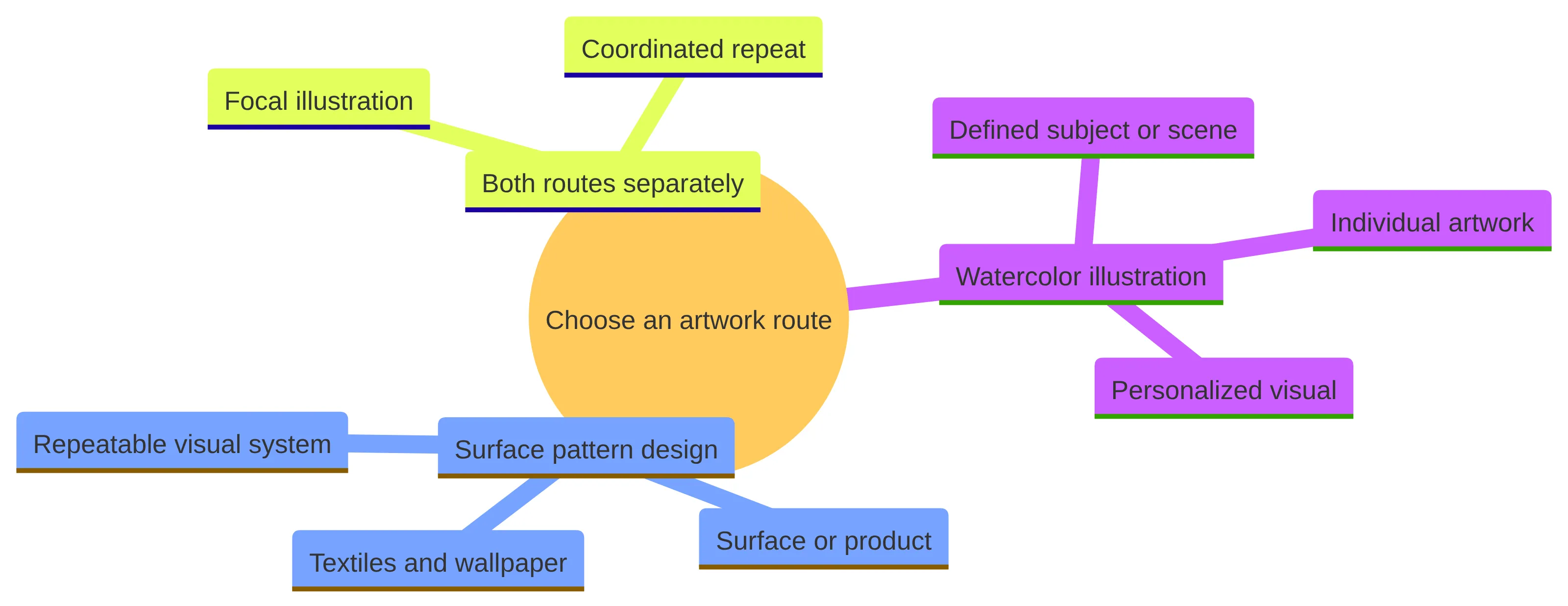
A watercolor illustration and a surface pattern solve different design problems. Watercolor illustration is a useful direction when the brief centers on a particular image, subject, or personalized visual. Surface pattern design is the relevant direction when artwork must repeat across a material or product surface; designs that repeat can be used for surfaces such as textiles and wallpaper.
The following comparison helps you name the route before you contact an artist.
| Project question | Watercolor illustration | Surface pattern design |
|---|---|---|
| What is the visual job? | Express a defined subject or scene as an individual piece of artwork. | Create a repeatable visual system for a surface, product, or collection. |
| What should you describe first? | Subject, mood, composition, colors, size, and details that must appear. | Product or surface, pattern style, colors, scale, repeat needs, and final format. |
| What should you inspect in a portfolio? | Comparable subjects, watercolor treatment, palette, and examples that resemble the intended mood. | Repeat quality, coordinated pattern work, surface applications, and production-ready examples. |
| What should you ask about? | The proposed image, references, revisions, and file delivery. |
The table is a decision aid, not a requirement to choose one route before contacting an artist. If your concept includes both a central illustration and a repeating product treatment, describe both parts separately so the scope stays understandable.
Use the route that matches the dominant job:
- Choose the illustration route when the subject, scene, or personalized image is the main point. Describe what must appear, how it should feel, and where the finished image will be used.
- Choose the pattern route when the artwork must cover or repeat across wallpaper, fabric, bedding, nursery decor, packaging, or another product application. Describe the surface, repeat need, scale, colors, and file format.
- Describe both routes separately when one project needs a focal illustration and a coordinated repeat. Identify which part is the individual image and which part is the surface treatment.
That distinction gives the artist a clearer starting point. Do not label a repeat project simply as a custom painting if the production requirement is the central issue.
Our surface-pattern work includes individual patterns and cohesive pattern collections, developed from initial concepts and sketches through final polished patterns. If your brief involves fabric, wallpaper, bedding, nursery decor, interior products, packaging, or another creative product application, identify the surface and the intended format in your inquiry. If your project is centered on one personalized image for a home setting, describe that image directly and ask whether watercolor illustration is the appropriate route.
Screen the portfolio for evidence of fit
Your portfolio review should test similarity, not just overall appeal. Review the artist’s work for comparable subject matter, preferred style, medium, color palette, and completed commissions before you decide that the fit is promising. A focused body of work and a curated selection of relevant pieces can tell you more than a scattered collection of unrelated experiments.
Use this screening sequence:
- Subject: Find work involving a subject, setting, or visual category close to yours.
- Medium: Look for watercolor work when watercolor handling is central to your brief.
- Style: Compare the level of detail, softness, structure, or painterly treatment with the direction you want.
- Palette: Check whether the colors in the portfolio can plausibly support your room, product, or collection.
- Completed commissions: Give weight to finished client work, not only personal studies.
- Communication: Notice whether the artist explains the commission process and answers practical questions directly.
You do not need to find an identical project. You do need enough comparable evidence to explain why the artist may understand your requested subject and visual direction.
A short comparison note can keep your judgment specific. For each portfolio example, record:
- The feature that relates to your subject or product
- The visual quality you want to carry into your project
- The difference between the example and your brief
- The question that difference creates
For example, you might note that a floral study matches your palette but does not show a repeat, or that a completed home commission matches your subject but uses a different level of detail. The point is not to assign a universal score. The point is to turn preference into a question you can ask before committing.
A portfolio cannot decide every project question for you. If the process or expectations are vague, ask for specifics before paying a deposit. The useful test is whether you can describe the connection between the portfolio examples and your own brief in concrete terms, rather than relying on a general feeling that the work is attractive.
Use portfolio examples to resolve style uncertainty
Your style preference may need more detail than “soft,” “modern,” or “traditional.” Pattern and custom-artwork styles can range from traditional or painterly to flat, intricate, casual, juvenile, or modern. Reference images help turn a vague preference into something an artist can discuss with you.
Choose two or three portfolio examples and compare them with your intended project. Ask yourself:
- Is the subject treated with the amount of detail you want?
- Does the composition leave room for the surrounding room or product?
- Do the colors support the atmosphere you described?
- Would the same visual direction work for a repeat, if your project needs one?
- Which parts of the example do you want to carry into your brief, and which parts do you want to change?
Portfolio examples make style discussion more precise because you can point to a visible reference instead of trying to define an artistic approach from a label alone.
Your style notes should separate visual qualities from the subject itself. You might want the same botanical subject to feel airy rather than dense, restrained rather than bright, or painterly rather than flat. You might also want a room image to guide the mood without copying its objects or arrangement. Write down the quality you are borrowing from each reference so the artist can distinguish inspiration from a literal instruction.
Use the examples to ask whether the proposed direction matches what you have in mind. This question creates a clear checkpoint before the project advances. If the examples support only part of your idea, name the gap directly and ask whether the artist sees the requested direction as a fit.
Check whether the requested output matches the service
Your requested output should match the type of work you are hiring. Surface pattern design involves repeatable designs for surfaces, while a pattern commission may also involve a single statement pattern, supporting patterns, or a coordinated collection. Decide whether you need one artwork, a repeat, several coordinated designs, or a combination before you write the inquiry.
Our custom surface patterns can also be developed for fabrics, products, packaging, and creative projects. If your home project involves a surface application, state the material and the place where the design will appear instead of describing it only as “artwork.”
These are specific output considerations, not automatic assumptions about every project. Write down the file type, repeat requirement, color or scale requirement, and production destination that you need to discuss.
Before you inquire, write one sentence that names the requested output. For example:
- “I need one watercolor illustration of a specific subject for display in a room.”
Replace the bracketed idea with your own subject, surface, and required format before sending the message.
Your action is simple: name the requested deliverable before requesting a quote or project discussion. If you cannot yet describe whether the output is an illustration, a repeat, or a collection, spend time clarifying the product or home application first.
Build an artist-ready project brief
Your project brief should give an artist enough information to understand the visual assignment before discussing the work.
Organize the brief under short headings:
- Subject: Explain what the artwork should show, including people, places, objects, plants, animals, or motifs that matter.
- Style: Describe the visual qualities you want and include examples when a style word could be interpreted in several ways.
- Mood: State whether the piece should feel quiet, playful, formal, nostalgic, natural, or otherwise distinct in tone.
- Background and composition: Explain the setting, arrangement, focal point, spacing, and any area that should remain open.
- Colors: List preferred colors, colors to avoid, and any room or product palette that the artwork needs to work with.
- Size and format: State dimensions, orientation, repeat requirements, and the file format you expect to discuss.
- Required details: Identify the elements that must appear and separate them from optional ideas.
This structure keeps the concept separate from the production questions. It also gives you a document to refine as you compare the project with an artist’s visible work.
A compact brief can open with the project’s purpose, then move from the visible idea to the practical output: “I am looking for artwork for [room, surface, or product]. The subject is [subject]. I want the piece to feel [mood] and use [colors or palette]. It should include [required details], fit [size or orientation], and be delivered in a format suitable for [intended use].”
Add the points that are specific to your project rather than sending a generic description. If the artwork will repeat, say so in the first paragraph. If it will remain a single image, describe the placement and dimensions instead.
We ask for your vision, references or inspiration, product type, preferred colors, pattern style, and required final format when starting a surface-pattern project. Include those details in the brief when your project involves a repeat or product application. The more clearly you separate the visual idea from the required output, the easier it is to discuss whether the service fits.
Attach references and state the project constraints
Your references should help the artist understand the idea you are describing. Useful materials can include photos, sketches, moodboards, brand assets, color palettes, or examples of work you like. Choose references that explain the subject, style, palette, composition, or product context instead of attaching a large group of images without labels.
Label each reference with its purpose. For example:
- “Use this photo for the subject and pose.”
- “Use this image for the color relationship.”
- “Use this portfolio example for the amount of detail.”
- “Use this room image to show the intended placement.”
- “Use this product image to show the surface and scale.”
This practice helps separate what you want to depict from how you want the finished artwork to feel. It also makes a later style conversation more specific.
You do not need to send every image that influenced the idea. Select the references that answer a project question and label the answer beside each file. A subject photograph can explain what should appear; a room image can explain placement; a palette can explain color; and a portfolio example can explain treatment. Keeping those purposes separate makes it easier to revise the brief without losing the central request.
Your project constraints belong in the first inquiry, not as a surprise after the creative direction has been discussed. Share your budget and other constraints upfront so the artist can assess the scope and price the work more accurately. For a surface-pattern project, include the product type, preferred colors, pattern style, and required final format. State the intended use, target dimensions, repeat needs, file requirements, and any deadline you need to discuss without assuming that a particular schedule is available.
Clarify personal, commercial, and licensing use
Your intended use affects the questions you need to ask. Tell the artist whether the artwork is for personal or commercial use because those uses can involve different pricing and usage terms. A painting for your home and artwork intended for products, packaging, publishing, advertising, or a brand project should not be described in the same general terms.
A licensing arrangement may cover a single pattern or an entire collection, and licensed surface-pattern artwork can be used for products such as wallpaper, fabric, stationery, or home décor. If your project involves products, ask whether you are discussing a single pattern or a collection and name the products where the artwork may appear. Do not leave the intended product category implicit.
Commissioning and licensing describe different questions in your inquiry. A commission discussion centers on creating artwork for your brief. A licensing discussion centers on the permitted use of an existing pattern or collection, or on the rights associated with artwork created for products. Your project may involve both, so name the artwork, products, surfaces, and use you want to discuss rather than assuming one arrangement covers every application.
Use these questions to keep the use discussion concrete:
- Is the project for personal display, a product, a brand, or another commercial purpose?
- Will the artwork appear on one item, several products, or a broader collection?
- Are you requesting an original commission, a surface pattern, or a licensing arrangement?
- Which products, surfaces, or channels should the intended use cover?
- What usage and licensing terms need to be discussed before approval?
Your job at this stage is to describe the intended use accurately and ask which terms will apply. Avoid treating a personal-artwork inquiry as if it automatically covers commercial products.
Confirm terms before committing
Your project should have clear terms before you commit money or approve the work. A commission agreement may address revision policy, payment terms, refunds, cancellations, subject-matter boundaries, licensing terms, and file-delivery details. Ask which revision, payment, cancellation, licensing, and file-delivery terms will apply to your project.
Your questions should also cover the path from brief to final file. Ask how the artist handles:
- Initial concept development or sketches
- Feedback and revision points
- Approval of the visual direction
- Final artwork preparation
- File delivery and required formats
- Changes to scope after the project begins
Clear communication is part of fit. Before paying a deposit, ask for specifics if the process or expectations are unclear. A direct answer does not remove the need to read the terms, but it gives you a concrete basis for deciding whether the working arrangement suits your project.
Your approval path should be understandable before the work starts. Identify who will give feedback, which stage requires approval, and what happens if the scope changes. For a project with several stakeholders, describe those review points in the brief. For a personal commission, state who will make the final decision and which details are essential. This keeps the creative discussion connected to the practical terms.
Your budget and constraints should be discussed alongside the creative brief. Sharing the real budget upfront helps the artist assess scope and price the work more accurately. If your needs exceed the initial idea, identify which parts are essential and which parts could be adjusted during the discussion rather than leaving the scope undefined.
Use a coordinator when the brief is complex
Your project may need coordination when several parties, production requirements, or approval stages are involved. For a complex project, an intermediary can translate requirements into an artist-facing brief and coordinate milestones related to schedule, scope, and technical constraints. This route is relevant when the project includes more communication layers than you can manage directly.
Consider coordination when your brief includes several of these conditions:
- A brand, manufacturer, designer, and artist all need to align.
- The artwork must meet technical requirements for a product or production process.
- Multiple people need to review concepts or approve revisions.
- The project contains several patterns, products, or milestones.
- The person commissioning the artwork is not the person managing production.
An intermediary does not replace the need for a clear brief. The intermediary helps translate requirements and manage milestones; your inquiry should still state the intended use, creative direction, deliverables, constraints, and decision-makers.
If coordination seems necessary, identify the handoffs before you begin. List who supplies the product requirements, who communicates with the artist, who reviews concepts, and who approves the final direction. Also identify the technical information that must reach the artist, such as the surface, format, scale, or production constraint. This turns a general concern about complexity into a specific coordination plan.
Your boundary is practical: use direct communication when you can give the artist a complete brief and make decisions efficiently; consider a coordinator when scope, technical requirements, or approvals create several points of possible misunderstanding. If you choose direct contact, put the main requirements in writing from the first inquiry.
Submit an inquiry that makes fit easy to assess
Your inquiry is ready when it gives the artist a concise view of the project and the decision you need to make. Include:
- The artwork’s job and intended setting or product
- Whether you need watercolor illustration, surface pattern design, or both
- The subject, style, mood, colors, composition, size, and required details
- Photos, sketches, moodboards, palettes, brand assets, or selected portfolio references
- The intended personal or commercial use
- Product type, repeat needs, final format, and production constraints where relevant
- Your budget and any timing or scope constraints you need to discuss
- Questions about revisions, payment, cancellation, licensing, and file delivery
We specialize in watercolor illustration and surface pattern design. Use those points to make your first message specific rather than sending only a general request for availability.
A useful first message can follow this order:
- State what the artwork must do and where it will be used.
- Name the subject, style, mood, palette, and required details.
- Identify the output: individual illustration, repeat, collection, or combined project.
- Attach the references that explain the subject, visual direction, and product context.
- State the intended use, budget, constraints, and questions about terms.
This order lets the artist see the creative request and the practical conditions together. It also gives you a final check: if a sentence is missing, the brief may still need clarification before you send it.
Your decision becomes clearer when the project need, portfolio evidence, output, and constraints point in the same direction. If you still have a material question about individual suitability, rights, or contractual consequences, seek advice from a qualified professional before committing. Then send the brief and references so the project can be assessed on its actual requirements.
What should you ask a watercolor artist before inquiring?
What should I include in a project brief for custom artwork?
A project brief should cover the subject, style, mood, background, colors, composition, size, and any required details that must appear in the final piece.
How can I assess if a watercolor artist is the right fit for my project?
Review the artist’s portfolio for work that matches your subject matter and preferred style. Look for completed commissions and ensure their medium and color palette align with your vision.
What types of projects can I hire a watercolor artist for?
You can hire a watercolor artist for personalized artwork, home decor, or surface pattern design for products like fabric and wallpaper.
What details should I prepare before contacting a watercolor artist?
Prepare details about the intended use, required project specifications, and any reference materials that can help the artist understand your vision.
What is the difference between commissioning artwork and requesting surface pattern design?
Commissioning artwork typically focuses on creating a unique piece for display, while surface pattern design involves creating repeatable designs for products or materials.
How should I communicate my budget and constraints to the artist?
Be transparent about your budget and any constraints upfront, as this helps the artist provide a more accurate assessment of the project scope and pricing.
What questions should I ask about licensing and usage rights?
Clarify whether the artwork is for personal or commercial use, and ask about the licensing terms for any patterns or designs you wish to use.


comments +