
Start with the room role before comparing artwork
Choosing artwork for home decor becomes easier when you decide what the piece needs to do before you decide what it should look like. You may want a finished image that fills an empty wall, a subject connected to your home or travels, a palette that settles into the room, or a design that repeats across a surface. Those details give you a brief for comparing artwork.
Start with the meaning you want the room to carry. A ready-made print can give you a defined subject and established visual language without asking you to develop an idea. Personalized watercolor can center a place, building, object, or memory that matters to you. An original commission gives you more direct involvement in the concept, while surface pattern design addresses repetition across products or architectural surfaces rather than a single focal image.
Write down these five decisions before you browse or contact an artist:
- Subject: What should the artwork show or suggest?
- Style: Should the room feel traditional, quiet, graphic, expressive, or connected to a particular visual tradition?
- Color: Which existing colors should the artwork repeat, soften, or contrast?
- Scale and placement: Will the piece fill a wall, sit above furniture, join a gallery wall, or appear across a surface?
- Personalization: Do you need a specific place, object, story, or pattern rather than a broadly suitable image?
This short brief turns a vague wish for something more personal into criteria you can use while comparing options.
After the room’s role and visual requirements are clear, make a readiness check. Choose a finished piece or print when you can evaluate an existing image against the brief; consider custom work when the subject or format still needs to be defined with an artist.
Map the artwork routes before you choose
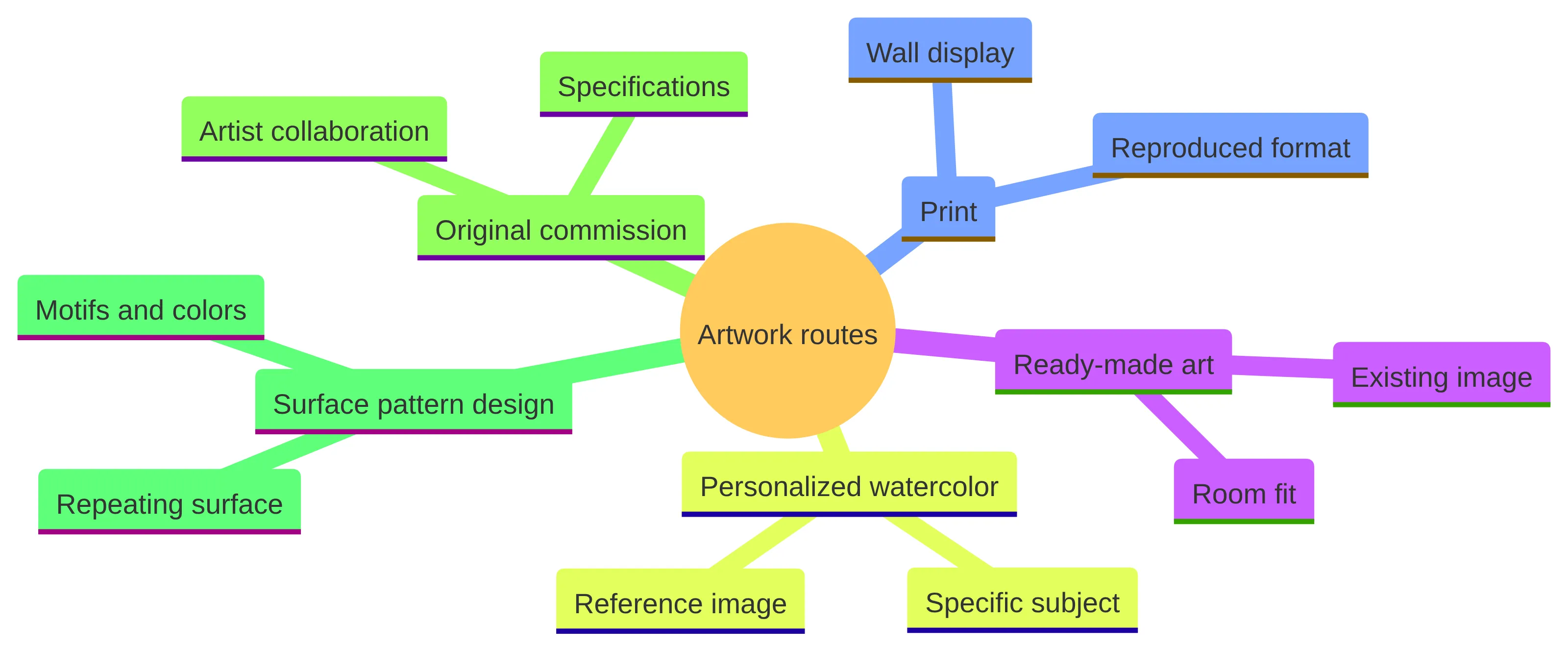
The main artwork routes differ by the question they answer. Personalized watercolor answers, “How can a particular subject become the image?” A commission answers, “How can I develop an original piece around my specifications?” Surface pattern design answers, “How should artwork repeat across a product or surface?”
| Artwork route | Best starting question | Personalization focus | Placement or format to consider |
|---|---|---|---|
| Ready-made art | Does an existing subject and style suit the room? | Your choice of image, frame, color, and arrangement | A single wall piece, framed print, or gallery wall |
| Do you want a defined artwork in a reproduced format? | Your selection and presentation choices | A wall display sized for the available space | |
| Personalized watercolor | What specific subject should the image preserve or express? | A place, building, object, or reference image | A focal wall piece or another defined artwork format |
| Original commission | What idea needs to be developed with an artist? | Your vision, preferences, and specifications | A physical artwork or digital deliverable, as agreed |
| Surface pattern design | Does the artwork need to repeat across a surface? | Motifs, colors, scale, and repeat structure | Wallpaper, wrapping paper, upholstery, fabric, or another surface |
Use the table as a sorting tool rather than a ranking. A route is suitable when its central job matches your brief. If you already know the image you want and need a straightforward wall decision, begin with ready-made art or prints. If the subject is personal but the format can remain simple, explore personalized watercolor. If the concept is still developing or needs an artist’s collaboration, prepare for a commission. If repetition is the defining requirement, investigate surface pattern design instead of forcing a single illustration to do a pattern’s job.
A surface pattern is not merely a larger illustration. Surface pattern design creates artwork for product surfaces, commonly as repeating patterns used on wallpaper, wrapping paper, upholstery, fabric, and floor coverings. That distinction matters because a pattern must be considered across a surface, while a standalone illustration is usually judged as one composition.
Overview
A useful home-decor artwork decision has four stages: define the room’s job, select the artwork route, test the visual criteria, and clarify the project details. You do not need to settle every detail at the beginning. You do need to know which decisions are fixed and which can remain open while you compare options.
Use this sequence:
- Name the room role. Decide whether the artwork should act as a focal point, support an existing arrangement, add a personal reference, or create continuity across a surface.
- Choose the degree of personalization. Separate a piece selected for its existing image from a piece shaped around your subject or specifications.
- Set visual boundaries. Record the subject, style, color relationships, scale, and placement before comparing listings or discussing a commission.
- Check the format. Confirm whether you want physical artwork, a print, a pattern application, or a digital file.
- Write down unresolved terms. Keep size, medium, timing, revisions, payments, and rights as questions until the specific project answers them.
This sequence prevents you from judging every option by the same standard. A finished print may succeed because it already has the right visual character; a commission may succeed because the concept can be developed around your specifications.
The practical test is simple: can you explain why the artwork belongs in the room without relying only on the phrase “I like it”? Your answer should connect the piece to at least one concrete factor, such as the room’s palette, the intended wall, a meaningful subject, or a repeated surface. If you cannot name that connection, return to the brief before choosing a format.
Choose ready-made art or prints when an existing image fits
Ready-made art or prints suit you when the main task is finding an existing image that works with the room. This route keeps the creative decision focused on selection: subject, style, palette, scale, frame, and arrangement. Traditional wall-art categories may include landscapes, still lifes, botanical illustrations, architectural imagery, and classical figurative subjects.
Begin with the subject rather than the product page. Ask whether the room needs a landscape, botanical reference, architectural image, still life, abstract treatment, or another visual cue. A subject that already belongs to your home’s story can feel more personal even when the artwork itself is not commissioned. If the room has no clear subject requirement, let the existing palette and furniture establish the narrower search.
Color should connect the artwork to the room without forcing every shade to match. Traditional-art palettes may include warm neutrals, deep earth tones, and soft natural hues, but those are category descriptions rather than rules for your home. Use them as prompts if they suit the room; otherwise, identify one or two colors already present and look for artwork that repeats, balances, or deliberately contrasts with them.
Traditional wall art is presented for spaces including living rooms, dining areas, bedrooms, offices, and entryways, so begin by matching the artwork’s visual weight and subject to the room where it will live rather than choosing a piece in isolation.
Choose this route when you can accept the subject and composition as they already exist. Compare the image against your wall, palette, and intended arrangement, then confirm the format and dimensions before you buy. If the artwork feels close but the subject still needs to be yours, move to personalized watercolor or a commission instead of trying to make a ready-made image carry a requirement it was not designed to meet.
Choose personalization when the subject must be yours
Personalized artwork belongs in your brief when the subject carries meaning that a general image cannot supply. That subject might be a home, a memorable building, a favorite route, a garden detail, or another place or object you want the room to hold. Personalization can concern the image itself, the palette, the composition, or the way the finished piece fits the room.
Watercolor illustration can be a useful route for a subject that should remain recognizable while retaining an interpreted, hand-painted character. The watercolor portrait page presents hand-painted watercolor portraits from photographs, including house-portrait examples. That example supports photo-based watercolor as a possible artwork direction; it does not establish that every artist uses the same source material, format, or project terms.
An original commission is different from selecting an existing image. A custom commission is an original piece created for you according to your vision, preferences, and specifications, and the commission guide describes it as a collaborative process in which you work directly with the artist to develop the idea. That collaboration can matter when the subject, mood, proportions, or visual references need discussion before the artwork takes final form.
Separate the personal subject from the visual treatment. For example, “our house” identifies the subject, but it does not yet say whether you want a detailed architectural view, a looser watercolor interpretation, a small accent image, or a broader scene. Add the following to your brief:
- The subject and why it belongs in the room.
- Reference photographs, sketches, or locations that explain the subject.
- The visual details that must remain recognizable.
- The details that may be interpreted by the artist.
- The intended room, wall, dimensions, and orientation.
- The colors that should appear, recede, or remain open.
A clear distinction between fixed requirements and open choices gives you something concrete to discuss without pretending that the finished artwork can be specified in every detail at the outset.
Choose personalized watercolor when the personal reference matters more than selecting from an existing catalogue. Choose a commission when you need an original concept developed around your specifications and are prepared to discuss the project terms that make that collaboration workable.
Use surface pattern when continuity across a surface matters
Surface pattern design addresses artwork that repeats across a surface rather than one image intended to be viewed as a single composition. One definition describes it as artwork for the surfaces of mass-manufactured products, commonly in repeating patterns; another describes patterns and prints added to surfaces and textiles. Examples include wallpaper, wrapping paper, upholstery, quilting fabric, apparel fabric, and floor coverings.
Choose this direction when continuity is the point. You may want a motif to continue across wallpaper, a textile to relate to the rest of the room, or a repeated design to carry a color story beyond one framed object. The question is not simply whether you like the motif at full size. The question is whether the motif, spacing, scale, and color remain suitable as the design repeats across the intended surface.
We treat hue, shape, line, and texture as essential components of surface pattern design. Use those four terms to make your brief more precise:
- Hue: Which colors should lead, support, or remain absent?
- Shape: Which motifs or silhouettes make the subject recognizable?
- Line: Should the design feel outlined, delicate, gestural, or more structured?
- Texture: Should the surface retain a visual sense of brushwork, material, or pattern density?
These choices help you discuss the character of the design without reducing the brief to a single reference image.
Do not select surface pattern design merely because you want a larger artwork. Select it when the repeated application is part of the desired result. If you want one image above a sofa, one architectural scene, or one personal subject, an illustration or finished artwork is the more direct route. If the same visual language needs to continue across a product or surface, prepare a pattern brief instead.
Before you explore this route, name the intended surface and the role of repetition. Record the motif, color family, approximate scale, and whether the design should feel dense or open. Then ask for project-specific information about the proposed format and deliverable before treating the pattern as ready for your home.
Compare subject, style, color, and personalization
A side-by-side comparison is useful when several routes could fit the same room. The table does not rank them. It shows where each route places the main decision so you can choose according to your brief rather than according to a general claim about what artwork should be.
| Route | Subject decision | Style and color decision | Personalization decision | Main room question |
|---|---|---|---|---|
| Ready-made art | Select from an existing subject | Judge the established composition and palette | Personalize through selection, framing, and arrangement | Does this finished image belong in the room? |
| Select an existing image in a reproduced format | Compare the image, finish, and presentation | Personalize through what you choose and how you display it | Does the format suit the wall and display plan? | |
| Personalized watercolor | Supply the subject or reference | Discuss the degree of interpretation and the palette | Make the image about your place, object, or memory | What must the artwork preserve or express? |
| Original commission | Develop the idea with the artist | Set visual preferences and open choices | Specify the concept, details, and intended use | Which parts of the concept need collaboration? |
| Surface pattern | Choose motifs that can repeat | Set hue, shape, line, texture, and repeat scale | Carry a personal visual language across a surface | Does repetition matter more than one focal image? |
Subject is the first filter because it determines what the artwork is about. A landscape or botanical image may support a room through atmosphere. An architectural subject may connect the room to a place. A personal home portrait may carry a more specific reference. A pattern may use a motif without presenting one complete scene. Choose the subject category that answers the room’s emotional or visual need, then judge the style within that category.
Style is not separate from placement. A detailed image may need enough wall space to be read clearly, while a quieter pattern may work through repetition. A traditional category can include landscapes, still lifes, botanical illustrations, architectural imagery, and classical figurative subjects, but those subjects can still vary in line, color, density, and presentation. Describe the specific character you want instead of relying on a broad label alone.
Color should be evaluated in the room where the artwork will appear. Look at the wall, nearby furniture, floor, textiles, lighting conditions, and objects that will remain. Decide whether the artwork should repeat an existing color, introduce a controlled contrast, or quiet a busy arrangement. Do not demand exact matching if the room needs visual separation; identify the relationship you want instead.
Personalization can be low, medium, or high without becoming a judgment about quality. Selecting a meaningful ready-made subject may be enough. A personalized watercolor can make the image itself specific. A commission can leave more of the concept open for collaboration. A surface pattern can personalize the room through recurring motifs and a distinct color system. Choose the level that gives you the meaning you want without adding a project process you do not need.
Mark one route as your current fit, then write the reason in one sentence using the table’s criteria. If you cannot name a clear reason, keep the route open and return to the room role, subject, or placement before comparing individual pieces.
Match scale and placement to the artwork’s role
Scale and placement determine how your artwork participates in the room. The same image can feel deliberate in one location and lost or crowded in another, so choose the wall and furniture relationship before you settle on a piece. A personal subject still needs a physical role.
A single artwork can act as a focal point above furniture, while multiple pieces can be arranged as a coordinated gallery wall. Use that distinction to decide what you are building:
- Focal piece: One artwork carries the visual attention above a sofa, mantel, console, bed, or another substantial anchor.
- Gallery arrangement: Several pieces work as a group, so their spacing, shared colors, and combined outer shape matter.
- Supporting piece: The artwork contributes to the room without becoming the only visual focus.
- Surface application: The design continues across a material or area, so repeat scale and coverage matter alongside the motif.
Measure the available wall and the furniture below it before you compare dimensions. Record the usable width, usable height, orientation, nearby obstacles, and the space required for the intended frame or mounting method. If you are considering a gallery wall, record the total arrangement rather than measuring only one piece. If you are considering a pattern, record the surface area and the visual distance from which the design will be seen.
Use the artwork’s visual density as part of the scale decision. A detailed architectural watercolor may need enough viewing distance for its features to read. A simple botanical motif may tolerate a different proportion. A repeated pattern can become visually heavy if the motif is too large or disappear if it is too small for the room. These are selection questions, not promises about how a particular design will perform.
Place the subject where its meaning supports the room’s use. An image of a home may feel most connected to a shared living area, while a quieter botanical subject may suit a bedroom or entryway; your own room, furniture, and preferences decide the fit. Keep the placement specific in the brief so the artist or seller can respond to the actual display plan.
Choose the intended role first, measure the available area second, and evaluate the artwork’s detail and repeat scale third. Do not approve a piece until its dimensions and format can be described in relation to the wall or surface where you plan to use it.
Apply the decision rule to your home-decor brief
A short decision rule can turn your notes into a practical direction. Your brief does not need to predict the finished artwork. It needs to identify the route that deserves your next comparison or conversation.
If the room needs an existing image quickly, choose ready-made art or a print. Use the room’s subject, palette, placement, and scale as filters. Select a finished image only when its existing composition is acceptable to you. Then confirm the dimensions, presentation, and intended display before purchasing.
If the room needs a specific subject, explore personalized watercolor. State what the image must show, supply useful references, and separate recognizable details from details open to interpretation. Photo-based hand-painted watercolor is one established direction shown by a selected watercolor portrait page, including house-portrait examples; project format and terms remain specific to the artist you contact. Choose this route when the subject itself is the reason a general print feels insufficient.
If the concept needs to be developed around your specifications, prepare for an original commission. Describe the vision, preferences, subject, room, and open choices. A commission is an original piece created for you according to those specifications and is described as a collaborative process with the artist. Move forward only after the project questions about scope and terms have clear answers.
If continuity across a product or surface is the main requirement, choose surface pattern design. Name the intended surface, motif, hue, shape, line, texture, and approximate repeat scale. Surface pattern design commonly concerns repeating artwork for surfaces such as wallpaper, wrapping paper, upholstery, fabric, and floor coverings. Use this route when the repeat is central, not as a substitute for a single focal illustration.
Finish your decision with a one-paragraph brief:
- Room and placement: Where will the artwork appear?
- Role: Is it a focal piece, supporting piece, gallery component, or surface application?
- Subject: What should it show or suggest?
- Style: What visual character belongs in the room?
- Color: Which relationships should the artwork have with the room?
- Scale: What dimensions or repeat range must the design accommodate?
- Personalization: Which details must be yours?
- Format: What physical or digital result are you considering?
The route that answers the most specific requirement is the route to investigate next. Keep the other routes as alternatives only if they solve the same room problem without weakening the personal detail you care about.
Test whether Kelly Swain’s specialties fit the brief
Our stated specialties are watercolor illustration and surface pattern design. Those specialties fit two different home-decor briefs: one centered on a defined illustrated subject and one centered on artwork that can operate as a repeating visual system. Use your brief to determine which direction you need before you make contact.
Our watercolor illustrations and surface pattern designs draw inspiration from historic architecture and vintage European patterns. That stated influence may be relevant if your home artwork brief involves architectural character, place-based references, or a pattern language with European inspiration. It does not decide the subject, size, color, or placement for your room; those choices remain part of your brief.
Test the fit with three questions:
- Does the subject belong to the practice you want to explore? A personal building, city reference, travel memory, or architectural detail may point toward illustration. A repeating motif or coordinated surface language may point toward pattern design.
- Does the visual direction match your room? Compare the desired line, hue, shape, texture, and level of detail with the existing space rather than treating the medium alone as the decision.
- Can you describe the intended use? Name the room, surface, approximate dimensions, orientation, and whether you are considering one artwork or a repeated application.
Answering these questions gives you a focused starting point and makes it easier to distinguish a suitable service conversation from a general request for home decor.
A useful inquiry can be concise:
- “I am choosing artwork for [room or location].”
- “The subject or motif is [specific reference].”
- “The artwork should feel [style or visual character].”
- “The room includes [relevant colors, furniture, or materials].”
- “I am considering [one illustration or a repeating surface application].”
- “The intended size, orientation, or surface is [known measurement or open question].”
Replace the brackets with your own details before you reach out. The goal is not to dictate every artistic choice. The goal is to communicate the decision the artwork must support.
Our specialties do not mean every artwork route or every residential format has the same project terms. Keep the request specific to watercolor illustration or surface pattern design, and carry the unresolved details into the questions you ask before approving custom work.
Ask the practical questions before commissioning
A strong creative fit still needs a clear project arrangement. Before commissioning, ask about the timeline, revision policy, payment schedule, cancellation terms, and how disputes are handled. These questions help define practical expectations before work begins.
Timeline and stages: Ask when the project would begin, what stages you should expect, when you will see progress, and what event marks completion. Keep the question tied to your project rather than assuming that another artist’s timing applies. Ask what information or approvals the artist needs from you at each stage.
Revisions and approvals: Ask how revisions work, when you can request them, and whether the agreement distinguishes between changes to the original brief and changes after an approved direction. Ask what happens if the subject, scale, color, or composition needs clarification. A revision question is most useful when you describe the point at which you expect to review the work.
Payments and cancellation: Ask for the payment schedule and the point at which each payment is due. Ask what the cancellation terms are and how an unfinished project would be handled. Do not assume that a deposit, installment, or cancellation arrangement is standard across artists; record the answer for the specific project.
Size, medium, and deliverable: Confirm the final size, medium, and whether you will receive a digital file or physical artwork. These are separate questions. A subject can remain the same while the medium, dimensions, and deliverable change the way you use it in your home.
Relevant examples: Ask for examples of completed commissions that resemble the subject, medium, or degree of personalization you are considering. Look for evidence that the artist can respond to the kind of brief you have, not merely work that looks attractive in a different context. Ask for an artist statement.
Put the questions in a written checklist:
- What is the intended timeline and what starts it?
- How many review or revision stages are included?
- What happens if the brief changes?
- What is the payment schedule?
- What are the cancellation terms?
- How are disputes handled?
- What are the final size and medium?
- Will the deliverable be physical artwork, a digital file, or both?
- Which examples are closest to this subject and style?
- What artist information will help you assess the fit?
A direct answer to each question gives you a clearer basis for deciding whether the project arrangement suits your home-decor plan.
Clarify copyright and usage rights before approving custom artwork
Copyright ownership and usage rights should be explicit before you approve custom artwork. Those questions are distinct from the subject, size, and medium, so keep them in their own part of your project notes.
Ask the artist to clarify:
- Who owns the copyright after payment?
- What uses are included for your home and personal display?
- May you reproduce the artwork for another purpose?
- May the artist display the work in a portfolio or promotional context?
- Are there restrictions on altering, sharing, or licensing the artwork?
- Does the answer differ between a physical original, a print, and a digital file?
The purpose of this list is to identify the terms you need to discuss. Do not treat a general assumption about custom art as the terms for your project.
Describe your intended use plainly. For example, tell the artist whether you want the work for display in your home only, whether you may need a digital copy for personal records, or whether you are considering additional reproductions. Specific intended use gives the conversation a concrete starting point.
Keep the ownership and usage answers with the rest of the project agreement before approving the artwork. If the terms do not match how you intend to use the piece, pause the decision and ask for clarification rather than treating the creative fit as sufficient.
Keep project-specific details as questions to confirm
Project details should remain questions until the artist or provider answers them for your specific artwork. This habit protects your brief from turning assumptions into requirements. It also keeps the creative conversation open where you have not yet decided the right format.
Use a confirmation sheet with five headings:
- Creative brief: What subject, reference images, style, color direction, and personal details will guide the work?
- Physical specification: What final size, orientation, medium, surface, and presentation are being considered?
- Process: What stages, review points, revisions, and approvals apply?
- Delivery: What will you receive, in what format, and at what point is the project complete?
- Terms: What payment, cancellation, dispute, copyright, and usage conditions apply?
Write an answer beside each question. Leave a blank rather than filling it with a guess.
For surface pattern design, add questions about the intended surface, repeat structure, motif scale, hue, shape, line, and texture. Our reference identifies hue, shape, line, and texture as essential components of surface pattern design. Asking about those elements helps you describe the visual system you want without assuming how the design will be prepared or applied.
For watercolor illustration, add questions about the subject reference, the degree of interpretation, the image orientation, the final dimensions, and whether the result will be physical artwork, a digital file, or another agreed format. Keep the question about interpretation open if you want the artist’s input; make it fixed only when a recognizable detail is essential to the meaning of the piece.
Return to your original room brief after the answers are collected. Confirm that the proposed artwork still has a clear subject, style, color relationship, scale, placement, and level of personalization. If one unresolved detail changes the route itself, such as moving from a standalone illustration to a repeating surface design, ask that question before approving the project.
Take the next step with a focused artwork brief
The right artwork route follows the job your room needs the piece to do. Choose ready-made art or prints when an existing subject and style already fit. Choose personalized watercolor when the image must refer to a specific place, object, or memory. Choose an original commission when the concept needs to be developed around your specifications. Choose surface pattern design when repeating artwork across a surface is the central requirement.
Before you move forward, prepare the short brief that will guide the conversation: name the room, placement, subject, style, color direction, scale, format, and personal details that matter most. Add the questions about timeline, revisions, payments, deliverables, copyright, and usage rights. A qualified professional decides individual suitability for a particular project, so use the brief to support that discussion rather than treating a general guide as a project agreement.
When your brief points toward watercolor illustration or surface pattern design, you can bring those details into an inquiry about the relevant service.
What should you confirm before buying or commissioning home artwork?
What should I consider when choosing artwork for home decor?
Start by defining the role of the artwork in the room, such as whether it should serve as a focal point or complement existing decor. Consider the subject, style, color, scale, and whether personalization is needed.
How can I personalize artwork for my home?
Personalization can involve selecting a specific subject that holds meaning for you, such as a favorite place or memory. You can also choose the colors and style that resonate with your existing decor.
What are the different routes for obtaining artwork for home decor?
You can choose ready-made art for convenience, personalized watercolor for specific subjects, original commissions for custom ideas, or surface pattern design for repeating motifs across products.
What practical questions should I ask before commissioning artwork?
Inquire about the artist’s timeline, revision policy, payment schedule, cancellation terms, and how they handle disputes. Also, confirm the final size, medium, and copyright ownership.
What is surface pattern design and when should I use it?
Surface pattern design involves creating artwork that repeats across surfaces, such as wallpaper or fabric. Use it when you need a cohesive design that carries a motif across a larger area.
How do I determine the right scale and placement for my artwork?
Measure the available wall space and consider the relationship between the artwork and surrounding furniture. Decide whether the piece will be a focal point, part of a gallery wall, or a supporting element.
What factors should I evaluate when selecting ready-made art?
Assess the subject, style, color, and scale of the artwork to ensure it fits well with your room’s decor. Consider how the piece will be displayed and whether it complements existing elements.


comments +